The role of the conformity auditor in quality management systems is often understood in a narrow and mechanistic framework. In many organizations, auditing is still viewed as an activity where items are verified one by one, checklists are applied, and boundaries are measured. In this understanding, the auditor becomes a material extension of the standard text; The task is only "Is there or isn't there?" is to answer the question. However, real control, especially in complex organizations, has to go far beyond this geometric view. Because the quality management system is not just a static structure consisting of procedures; It is a living network of relationships established between processes, decision points, information flows, learning cycles and corporate memory.
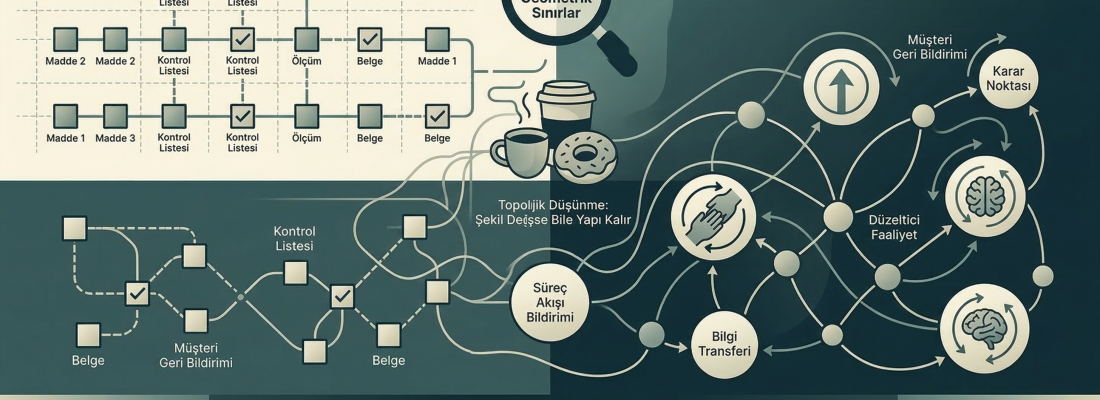
For this very reason, the thinking of a competent compliance auditor must have a topological character, whether he is aware of it or not. Geometry deals with shapes, boundaries, dimensions and fixed forms. Topology asks another question: Which feature of a structure is preserved even if it bends, stretches, or changes shape? What makes a system a system? This is exactly what the auditor should really look for in quality management systems. Not the form of the procedures, but the way the processes are connected; not the perfect appearance of the documents, but the internal connectivity that shows whether the organization is really functioning.
An organization's quality system may appear flawless on paper. Procedures have been written, instructions have been prepared, responsibilities have been defined, registration forms have been drawn up. However, organizational reality is often hidden beneath this surface order. If there is no real flow between processes, if information is produced at one point and cannot be transferred to another point, if mistakes do not turn into learning and responsibilities remain defined only in documents, the system is functionally weak even if it seems technically suitable. Here, the auditor cannot be satisfied with just checking each node one by one. It should also track movement between nodes. Does customer feedback really influence design? Is nonconformity analysis reflected in purchasing or production decisions? Is the management review a ritual or a centerpiece that can truly change the direction of the system?
This is where the power of the topological view emerges. Because the quality management system is not the sum of separate departments, but different nodes of the same network. Purchasing, production, quality control, customer complaints, corrective actions and management decisions are not isolated areas; They are the circulatory structures of the same system. The strength of a network depends on the continuity of the connection between nodes, rather than the number of nodes. The same goes for quality management systems. Procedures may change, teams may transform, tasks may be redistributed, departments may merge or separate. The organization is under constant deformation. But if connectivity is preserved, the system continues to live. This is what topology says: shape may change, structure may remain.
Therefore, a good auditor is not someone who gets caught up in surface roughness. Of course, nonconformities are detected, records are examined, and standard items are verified. But these are just the geometric layer of control. The main thing is to understand the internal logic of the system. At what point is information produced? At what point is the decision made? At what point does the system learn? And perhaps most importantly: Does this learning actually enter the institutional circulation?
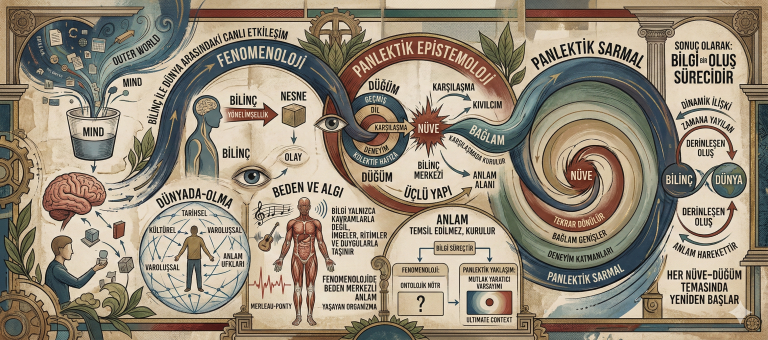
An important parallel with phenomenological thought emerges here. Phenomenology tells us that meaning is not found ready-made within objects, but is established in the encounter between consciousness and the object. Meaning opens up in relationship. Information is not a passive data, but an event that arises within a relationship. A similar situation exists in quality systems. Quality is not a ready-made essence hidden in procedures. It occurs when processes are linked together in the right context. A procedure alone does not produce quality; But a properly functioning process network makes quality visible. Therefore, the auditor's task is only to ask "is the document available?" not to ask the question, but “do meaning and function really emerge within this network?” is to approach the question.
The topological audit approach requires the auditor to focus on three basic structures. The first is connectivity. Are the processes truly interconnected, or do they only appear to be linked within schemas and procedures? The second is circulation. Can information move within the organization? Can a mistake turn into learning, a complaint into improvement, an analysis into a decision change? The third is durability. Can the system work under change? If the process does not collapse when people change, the structure does not fall apart when tasks are transferred, and the organization can adapt to new conditions, this system is topologically sound.
This view is also strongly compatible with modern complex systems theories. Because the contemporary understanding of organization no longer sees institutions as linear machines but as adaptive networks. It is not a coincidence that risk-based thinking is so prominent in modern management systems. Risks often arise not from a single lack of procedure, but from disconnections. Most of the time the problem is not in the node, but in the invisible space between the nodes.
At this point, topology is no longer just a mathematical metaphor; It turns into a broader way of thinking. In the simplest terms, topology is the science of relationships, not shape. The classic coffee mug and bagel analogy clearly demonstrates this. Geometrically, one is cup-shaped and the other is ring-shaped; but topologically, they are both single-hole structures. Their shapes are different, their connection patterns are similar. In daily life, metro maps work on the same principle. Actual distances are distorted, the angle of streets is not preserved, geographical accuracy is sacrificed; but people still find the way. Because what is important is not the size, but how the stations are connected to each other. Therefore, topology teaches us that the truth of a structure is sometimes hidden not in its visible form, but in its invisible relationships.
From here we can move on to a deeper philosophical question: Can something be genuine and effective even if it does not fit into our mental patterns? The answer to topology is clear: Yes. The human mind often tends to understand the world in geometric form. Draws boundaries, establishes categories, places objects in boxes. This tendency provides order but does not always capture the fluid nature of reality. However, nature, society, knowledge, language and organization often operate not as solid forms, but as a network of relationships. The formal organizational chart is geometric; but it is the often invisible topological network that determines how things really work. There can be a big difference between the official structure and actual circulation. Therefore, even if a system does not conform to our conceptual habits, it can be both genuine and effective if its internal connections are strong.
Philosophical thinking itself is largely nourished by this relational intuition. Philosophy is often the ability to recognize hidden connections between seemingly disconnected phenomena, rather than producing new data. The originality of great thinkers often arises not from inventing a new concept, but from associating concepts that no one has brought together before. Nietzsche makes visible the link between morality and power relations; Marx establishes the link between economy and ideology; Foucault reveals the pattern between knowledge and power. All of this is a movement of thought from geometric distinctions to topological connections.
Therefore, although the expression "phenomenological topology" is not an established discipline name, it can be seen as an extremely productive intellectual suggestion. Phenomenology considers the semantic field of experience, while topology considers the relational architecture of the structure. When these two orientations are combined, it becomes possible to understand human experience and knowledge as nodes and connections rather than fixed categories. Locke opened the mind from authority to experience by emphasizing that knowledge cannot be established without experience. Husserl showed that meaning is constituted in intention. Merleau-Ponty made the body and perception central to experiencing the world relationally rather than geometrically. Heidegger thought of the world not as a collection of objects but as a network of contexts of meaning. Whitehead, on the other hand, treated reality as processes and occurrences, not fixed entities. The common thread of these thinkers is that they seek the essence of reality not in singular forms but in relational fields.
This is exactly where it is necessary to rethink the idea of university, academy and doctorate. The word “Universitas” historically referred to a community of teachers and learners rather than a building or campus. In other words, the essence of the university is not place but relationship; It is not the storage of information in one place, but its circulation between minds. In this sense, universitas is not a geometric but a topological idea. It implies a thought order that does not confine knowledge within boundaries, but establishes a fluid integrity between fields.
On the other hand, the modern university structure has become largely geometric. Faculties, departments, departments, boundaries of expertise... Information is separated by lines and divided into measurable and manageable parts. This setup can be powerful for productivity; However, it often turns information into disconnected islands. However, the idea of universitas requires building bridges between these islands and thinking about the invisible connections between the parts. This is perhaps the great paradox of modern science: while the doctoral degree still bears the title “Doctor of Philosophy,” the way of thinking is becoming less and less philosophical.
Ph.D. historically it is not just a specialist certification. It implies that a person has now reached maturity to position technical knowledge in his field within a broader intellectual horizon. But today, many people with a doctorate can receive this title without having a serious encounter with even the most fundamental figures of classical and modern philosophy. Becoming a “Doctor of Philosophy” only through technical specialization, without any contact with Aristotle's causality, Hume's criticism, Kant's limits of knowledge, Locke's understanding of experience, Husserl's intentionality, Merleau-Ponty's bodily perception, Heidegger's idea of being-in-the-world or Whitehead's process ontology, widens the distance between the spirit of the name and the practice of the title.
However, great scientific leaps often occur thanks to this philosophical reflex. Newton was doing natural philosophy; Einstein reestablished the relationship between physics and geometry; Nash created a structural revolution in economics based on mathematics. Nash's importance is not only that he discovered a concept of equilibrium. He viewed players' decisions not one by one, but as a strategy space formed by mutual dependencies. Each player's decision depended on the decision of the others; that is, the issue was less about individual preferences and more about relational structure. This intuition bears a deep kinship with topological thinking. Nash was no economist; but he was able to see the structure that the economy was looking for. Because the real issue was not the domain name, but the structural intuition.
Therefore, a real doctorate is not just about producing new data; is to see invisible relationships. It is not enough to specialize in one field. It is necessary to be able to see how that field is connected to other fields, from what historical and philosophical basis its concepts come, and on what assumptions it is built. For this very reason, philosophy is not a luxury, but an essential element of intellectual circulation. What directs science is not only the method, but also the consciousness that can understand what the method means.
Perhaps the basic truth that should be remembered today is this: Information is accumulated in pieces, but the truth often becomes visible in connections. The same principle applies from quality systems to the idea of a university, from auditing to the doctoral ideal. Looking at the surface is geometry; Understanding structure is topology. The documentation is easy to read; It is difficult to see flows. It is possible to verify items; But only those who can read relationships can understand whether a system is truly alive or not.
Therefore, there is a deeper partnership than one might think between the competent auditor, the true academician, and the genuine PhD holder. All three must cross the surface. All three must be able to see the connections operating beneath the forms. And perhaps this is the highest form of thinking: being able to grasp objects not one by one, but within the invisible architecture that connects them.