Gökdere Road
The morning in Tokat wasn’t fully awake yet. A faint chill drifted over the cobblestone streets, and the street lamps glowed dimly against the daylight. The doors of the houses were closed. From behind some windows, the small sounds of the day just beginning could be heard.
In the distance, smoke rose from a bakery chimney, and the smell of bread spread slowly through the narrow streets.
Âdem had gotten up early that morning. There was a excitement he couldn’t hide. Together with his grandfather, Nurettin Bey, he would go to Gökdere Village. At the foot of Çamlıbel Mountain, at the end of roads that wound and curled, there was a small dairy. For years, Nurettin Bey made his yogurt and bought his cheese from there. In his view, that cheese couldn’t be found anywhere else; its saltiness, its scent, its effort—everything was different.
Mrs. Nurhan tied a thin scarf around her son’s neck beside the door.
“Mornings are cool,” she said. “Don’t catch a chill.”
Âdem nodded. His thoughts weren’t on the scarf or the coolness. He was looking at his grandfather’s old leather satchel—the way it stood upright in front of the door—at the serious yet gentle expression on his face. In every movement of Nurettin Bey, there was a measured order. Even lifting the bag, closing the door, stepping into the street felt like part of a discipline that had been learned years ago and never changed.
They walked toward Behzat Boulevard. The city was slowly waking up. The first breads coming out of the bakeries were lined up on the counters. A few shopkeepers had raised their shutters halfway, preparing for the day without breaking the quiet of the morning too much. Âdem walked a few steps behind his grandfather. Nurettin Bey’s shoulders were broad; his age had advanced, but there was still a sturdy upright strength in his stride.
A journey that began in the cool of the morning.
Tokat Bus Station
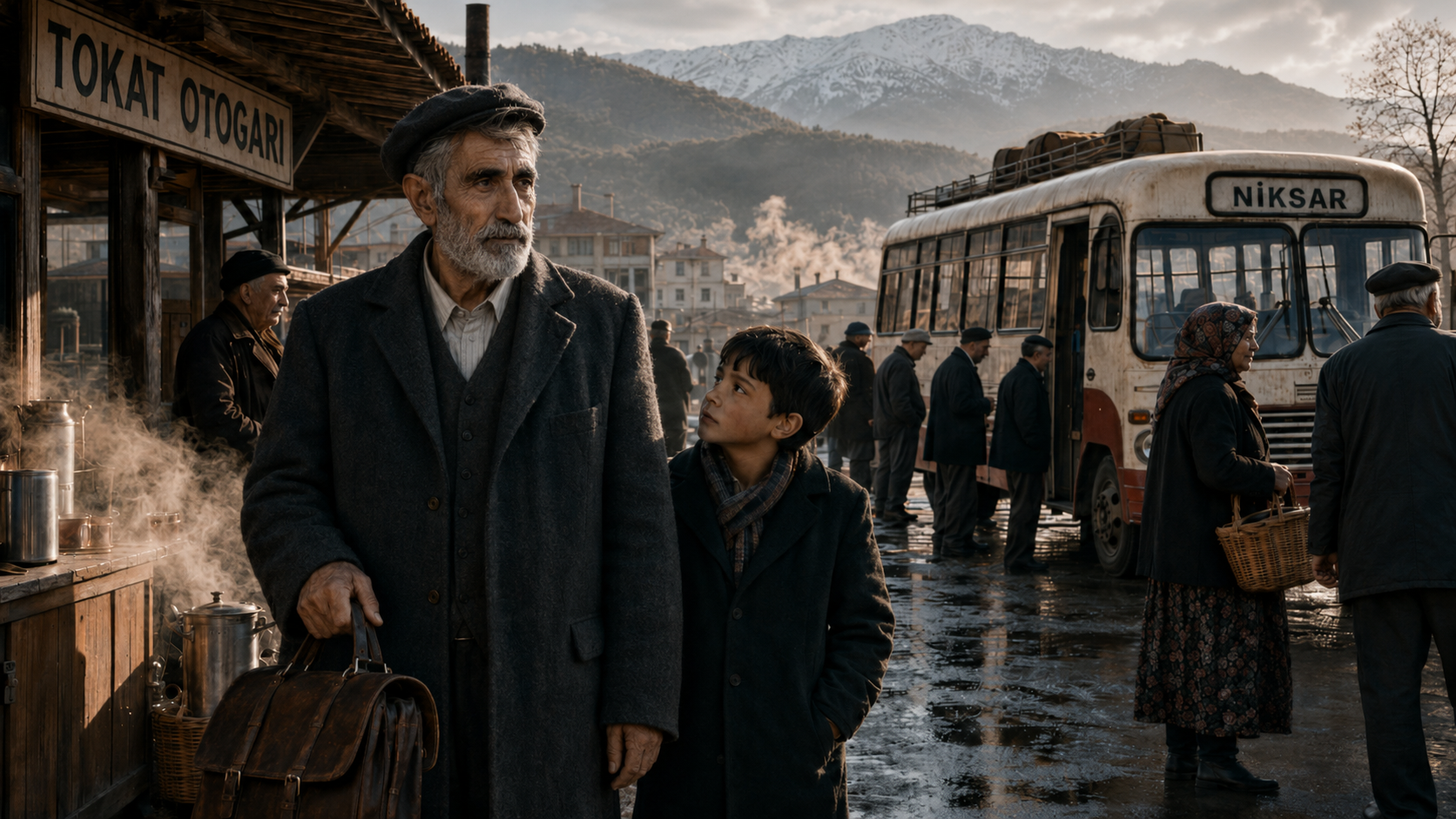
When they arrived at the old Tokat Bus Station, the atmosphere turned completely different.
The city still looked calm, but the bus terminal had already woken up. Tea glasses sent up wisps of steam in front of the small kiosks; women coming from the village waited with their headscarves on and baskets in their arms. The men puffed on their cigarettes, their hands tucked into the pockets of their vests as they silently endured the morning chill. The conductors’ voices mixed with the roar of engines:
“Erbaa… Niksar… Reşadiye…”
The smell of diesel had spread through the air. The footsteps on the stone ground, the rustle of baskets, a distant cough, and the muffled vibrations of working engines blended together. Inside the crowd, Âdem felt both small and careful. Everyone was going somewhere, everyone was carrying something—within all of them, there was a story that belonged only to them.
Nurettin Bey raised his hand to hail the old-model minibus in the distance.
“We’ll go to Gökdere,” he said.
The driver tilted his head as if recognizing him and opened the door.
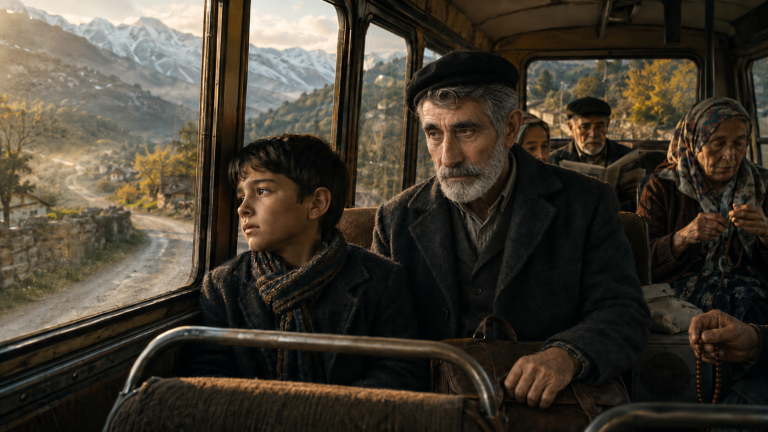
When they got inside, the smell of old upholstery hit their faces. The seats were thick, but they had sunk. Some edges of cushions were torn, and the foam inside was visible. By the window sat elderly women in baggy trousers and wool socks. On someone’s lap there were cheeses wrapped in a white sheet. A man opened the newspaper with both hands and moved slowly over the headlines. The man beside him drew his rosary quietly; even before the engine started, the soft sound of the beads touching could be heard.
In one corner, a young man was fiddling with an old radio. A crackling folk melody rose; first muffled, then a bit clearer. The sound left behind an old-country feeling inside the minibus before the road even climbed toward the mountain.
When the minibus began to move, its body jolted once. Âdem noticed right away. It was a kind of shaking that wasn’t in his father’s car. The vehicle first slumped backward, then settled onto the road. The vibrations coming from beneath the seats traveled to his legs and then up to his back. The city slowly fell behind.
The road stretched toward the Niksar side, where mist carried at the head. It was a little past eight. The sun was warming the city anew; when it struck the mountain, the light spread differently. As the road curved, the stones gleamed, the dips grew darker, and the shade of green changed with each bend. The hardness of the village road traveled from the wheels to the seat and then to Âdem’s body.
As the minibus passed through the town, the smell of bread rising from a roadside bakery made Âdem’s stomach growl. Then the road curved again. Wildflowers had opened in bursts of color along the edges. The sky was clear. The blue, as if it meant something else that morning. The sun slipping between the hills shone onto the mountain peaks covered with snow, and Âdem looked outside as though he were hypnotized.
Along the way, Nurettin Bey kept his eyes from leaving the scenery. After a while, he indicated the outside with his head.
“Look,” he said.
Âdem leaned closer to the window.
“What is it?”
Nurettin Bey pointed with his hand to the winding road below.
“We passed through there just a moment ago. Now it looks even clearer.”
Âdem looked out. The twists and turns they had just gone through now stretched along the mountainside like a thin line. As the minibus climbed, the houses shrank, the stream became more distinct, and the spaces between fields could be picked out.
“Everything gets smaller,” Âdem said.
Nurettin Bey smiled. “It isn’t getting smaller. It’s coming together the way you can see it.”
Âdem didn’t fully understand, but his curiosity continued. On the other hand, in that moment, he saw not what his grandfather meant, but how the road outside had changed. The bend that had shaken them a little while ago was, from far away, connecting through other routes.
After a while, the sun slipped down from the mountainside and fell into the minibus. The edge of the old woman’s headscarf lit up. Then the light moved on and struck the man’s fingers holding the newspaper. The cheese sheet whitened for a moment, then melted back into shadow.
Âdem looked out through the glass. His own face appeared in the minibus window like a faint shadow, and the road outside passed through that shadow. For a moment, he felt as if he were both inside and looking at himself from outside.
A few people walking by the roadside turned toward the minibus. One of them narrowed his eyes and looked at the glass, as if trying to pick someone out inside. Another lifted his head slightly; his face brightened as though he had run into someone familiar. Âdem’s heart stirred with a small joy in that moment. Maybe they had seen him. Maybe they really were looking at him.
Then both of them turned their heads away. One adjusted the sack on his shoulder, and the other stepped by a stone at the edge of the road and continued walking. As the minibus passed, their faces returned to normal. That glance left behind, as if it had never happened.
A strange emptiness formed inside Âdem. It felt as though he had been seen; yet he hadn’t been. For an instant he stood there as if he might be recognized, then he remained just like any other child in the crowd. The seat’s vibration continued in his legs, and the cold of the glass sat close to his face.
Then he spoke in a distracted voice:
“Grandpa, we’re here right now… We’re really inside this minibus, aren’t we?”
Nurettin Bey looked at his grandson. After a brief silence, he said, “What do you mean by that? Of course we’re here. You’re sitting right next to me.”
“I don’t know,” Âdem said. “They looked at us a moment ago. It was like they were about to recognize us, then they turned their heads away. Did they see us? Did they see us as ourselves, or were we just a full minibus passing by?”
“Of course they saw us,” said Nurettin Bey. “They have eyes. But it’s normal they didn’t greet us because they didn’t recognize us.”
Âdem frowned. “So they don’t really see us—that real us? Are we only a crowd to them? But I met their eyes with a few people. They seemed to know you and me.”
“It can be like that,” said Nurettin Bey. “People sometimes look out of curiosity, sometimes with instinct.”
The grandfather softened his voice. “What are you trying to learn?”
Âdem turned back to the glass. He saw his own face in the glass. The road outside flowed over the top of his face.
“So when is a person really seen?” he asked.
Nurettin Bey placed his hand on his grandson’s shoulder.
“If someone calls you by your name. Or if someone is waiting for you. Or if, without you telling, they understand you from your face.”
“Do you understand?”
The grandfather smiled faintly. “Sometimes.”
“Now do you understand?”
“A bit.”
“What did you understand?”
Nurettin Bey adjusted Âdem’s scarf. “Something’s caught on you,” he said.
Âdem looked away. The answer felt strange to him. He was embarrassed, and at the same time he was glad his grandfather had figured it out.
“It’s caught,” he said in a low voice.
The grandfather nodded. “Good. Let it be caught. Then you’ll ask again later.”
The minibus went into a pothole. Both of them jolted slightly. Nurettin Bey held Âdem from his shoulder. Âdem looked back at the window again. There was his own face in the glass. Next to it, his grandfather’s face could be seen faintly, too. One basket shifted; an elderly woman held it steady with her hand. The folk song on the radio got mixed into a crackle.
The conversation ended there.
After a while, another question came to Âdem’s mind.
“Grandpa, why are we going to the village? We’re making such a long trip just to buy cheese from that dairy man. In Tokat, we could’ve gotten it from any grocery store.”
Nurettin Bey gently patted Âdem’s head and laughed.
“We could have. But I always get it from that uncle.”
“Why?”
“Because I know how he puts in effort—and how he turns that effort into flavor and quality.”
Âdem looked at the empty bag in his hands. “So it isn’t enough just to buy it.”
Nurettin Bey nodded. “It’s not enough. You also have to know its value. If you don’t value things, life will put people in front of you who don’t value anything either.”
Those words settled into Âdem’s heart like a warm, heavy responsibility. A trip made to buy cheese had turned from merely shopping into something else. Behind that cheese were a man’s morning, feeding his animals, the milk boiling, the tuning of the salt, the dairy’s scent, the village’s soil, and the hardship of the road. What makes something valuable isn’t only how it tastes; it’s the effort behind it.
The minibus turned onto a dirt road. Potholes increased. The mountain’s coolness still touched their skin; as the sun rose, a fine warmth mixed into the chill. As they approached the village, the houses along the roadside grew sparser. You could see a few mudbrick walls, a few gardens, and buckets sitting in front of stable doors. The chickens scattered away from the roadside. A child stood at the edge of the road; he dug at the soil with a stick in his hand and looked at the minibus.
Gökdere
When they arrived at Gökdere Village, the minibus stopped near the square.
First Nurettin Bey got off and then extended his hand to Âdem. When the child set his foot on the ground, he felt he had left the city. The soil wasn’t soft, but it was alive. In the air there was a mixed scent of milk, hay, damp earth, and wood smoke. The village felt like a place that didn’t rush. Everyone knew everyone; every sound came from one place and settled somewhere else.
“Let’s walk around a bit,” said Nurettin Bey. “Here, we don’t have to hurry.”
Âdem walked beside his grandfather. In the square, a few men greeted them. A woman was washing a copper basin in front of a door. In the distance, a cow lowed. As Nurettin Bey moved toward the dairy, he spoke briefly with everyone; he didn’t give too many words to anyone, but he also didn’t brush anyone off. Âdem watched. In the relationship his grandfather built with people, there was a strange balance: there wasn’t a distance from above, nor closeness that would scatter him. It was a stance that gave everyone as much space as they deserved.
When they entered the dairy, it was cool inside. The stone walls had kept the chill of the morning. Large churns held yogurt, and in one corner, cheeses were draining. The sour yet clean smell of milk spread through the air. The dairy man smiled when he saw Nurettin Bey.
“Welcome, Nurettin Bey.”
“Glad to see you,” said the grandfather. “This is my grandson, Âdem.”
The man looked at Âdem. “So you’re Âdem.”
That sentence pleased Âdem. In that moment he wasn’t only the child from the minibus; he was someone called by name, noticed, and placed in a person’s gaze. The question he had asked on the road returned to his mind. Being visible is one thing; being understood is another. Here, people didn’t trade only their faces to one another—they exchanged effort, stories, and names.
The cheeses were weighed. The yogurts were put into the containers. When Nurettin Bey paid, he didn’t bargain. Âdem was surprised.
“Grandpa,” he said as they stepped from the dairy’s doorway into the courtyard, while the cheese’s salt was still on his tongue, “you didn’t bargain at all.” Nurettin Bey pulled the bag in his hand up a little; it found its place with the soft rustle of the damp bag clinging to the joints of his fingers. A breath came out of his mouth with the smell of milk, overlaid with cigarette smoke. “Not everything is subject to bargaining, my child.” His eyes caught on a bucket in the corner of the courtyard; the milk that had just spilled onto the ground was mixing with the water and running in a thin line. “I told you—I know the effort behind it.”
Âdem looked at the small package in his hand. That package was no longer only food. Inside it were the road they traveled, the coolness of the morning, the jolting of the minibus, the mountain’s light, the dairy man’s effort, and his grandfather’s words.
Passing by the square in Gökdere, Âdem’s eyes caught on a child by the fountain. The child was drinking water with his palm, and in his other hand he carried half-eaten orange and the peels. In that moment, Âdem didn’t dwell on it. He was a child; he had looked, he had seen, and then he had gone on his way. It was one of the ordinary details of the square: the water spilling from the fountain, the man wearing a cap in front of the coffeehouse, the woman greeting with her head, the soft sound the damp earth leaves under shoes, and the peel in that child’s hand.
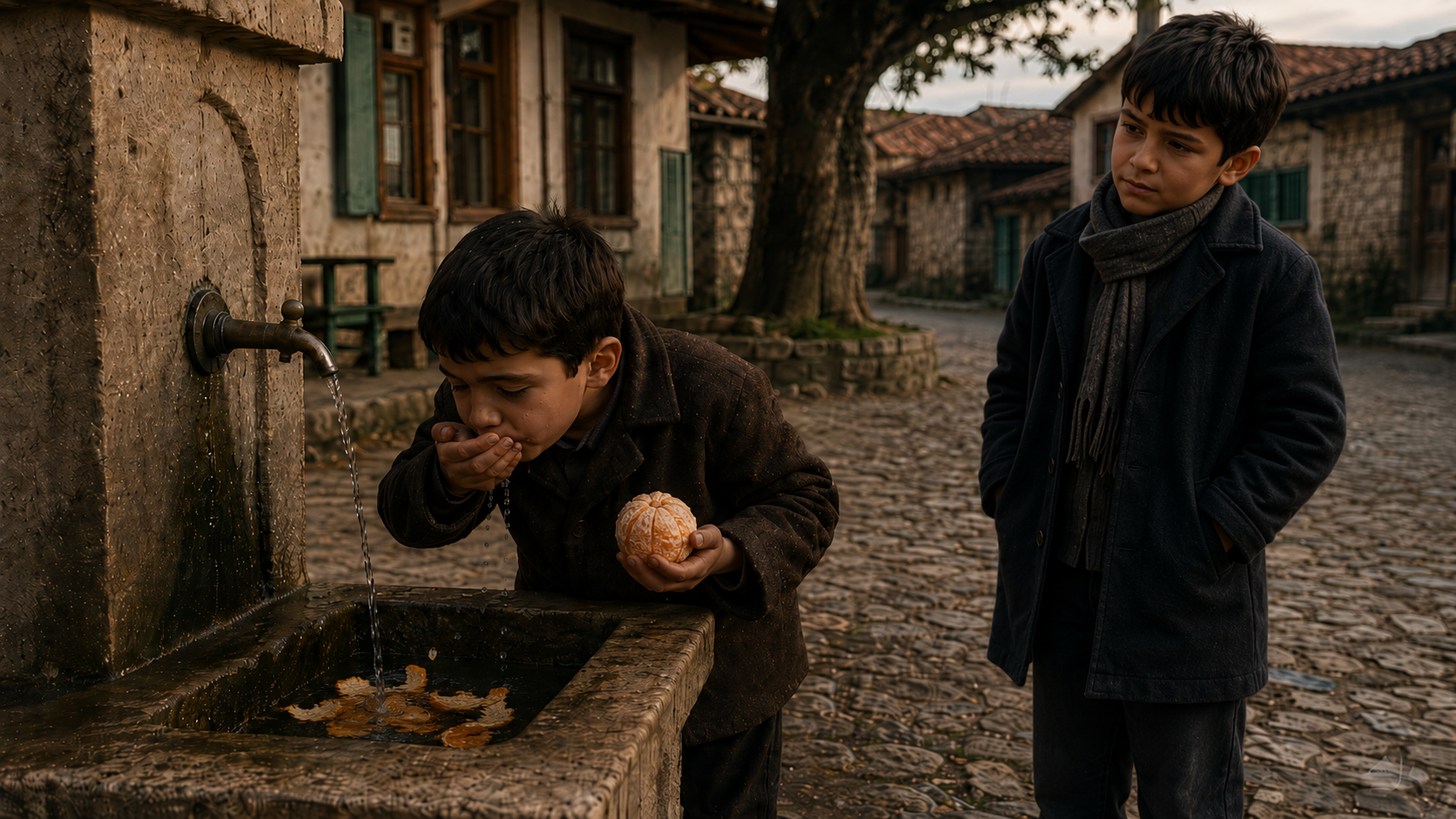
The child by the fountain had seemed like a mere ordinary detail that day.
Orange Peel
Years later, when Âdem returned to the same scene on his deathbed, that small detail grew bigger. Now he looked at it not with a child’s eyes, but with a consciousness that had moved through life. The fountain was still running. The woman was still greeting with her head. The man in front of the coffeehouse held his cigarette between two fingers. The child was still there; even the water of the orange and the peel in his hands didn’t seem to have dried.
That day he had gone to Gökdere. Not to a village, but to the first door of his own thoughts.
For the first time, he had sensed there that stepping out of narrow streets and looking from above didn’t mean understanding. He had sensed that the value of something could only be grasped by the effort that touched it.
The first stir of the thought he would later name Panlectic may well have been born right there: in the minibus window, in the light hitting the mountain, in the hand resting on his grandfather’s knee, in the jolting of the Gökdere road.
Âdem was a child that day. But some days of childhood keep growing inside a person.
Gökdere stayed that way, too.
More than a village—an outlook.