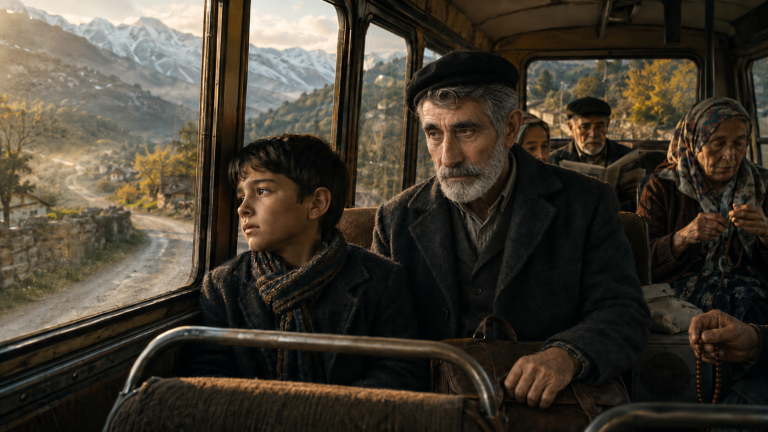
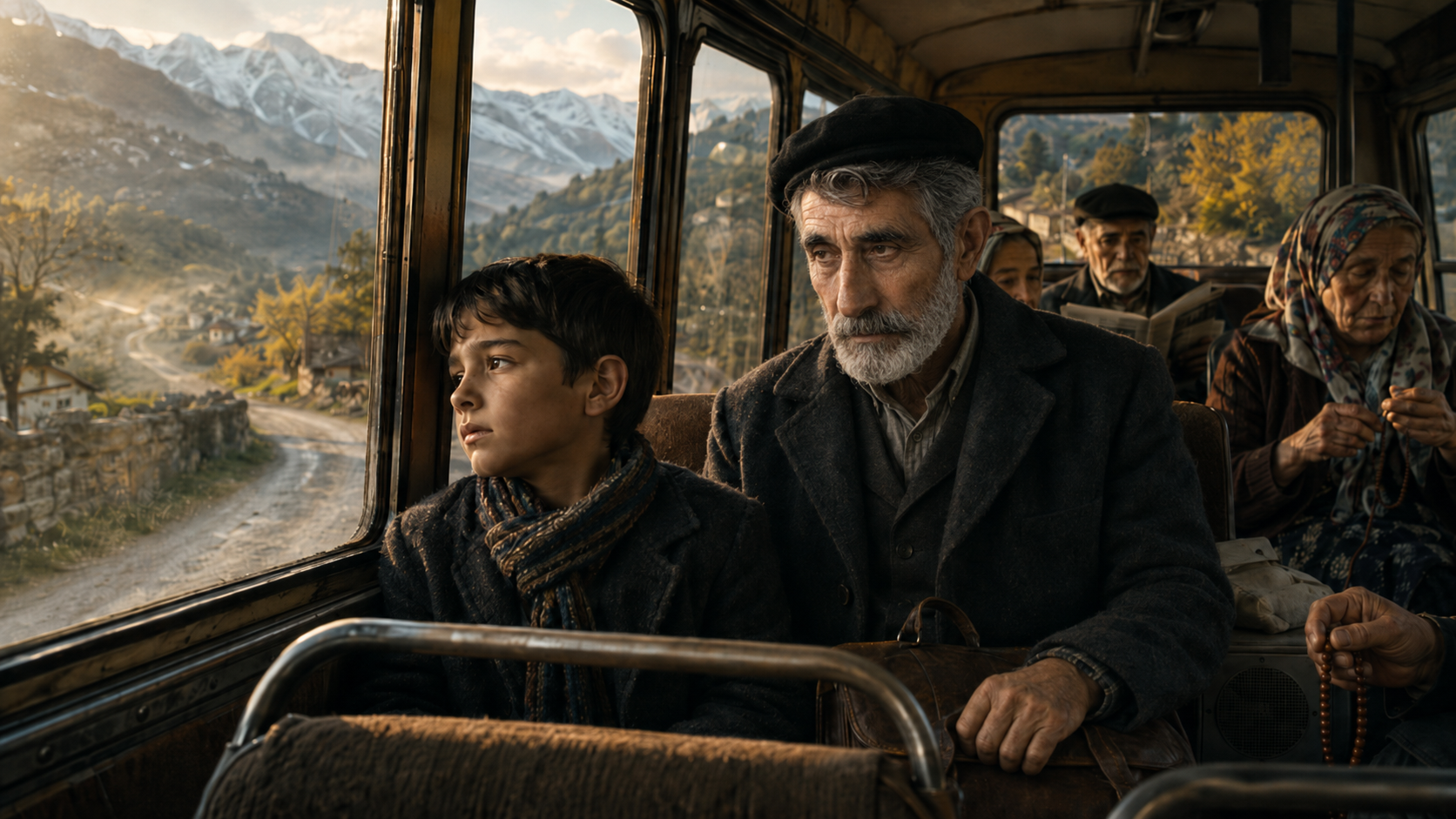
He had been sitting for a long time in the pastry shop where he would meet Mavi. He had watched the wall clock, the tea whose steam was thinning, and the door opening and closing. Mavi did not come. Âdem did not go home either. He walked to the National Library.
While wandering among the shelves without knowing what he was looking for, he saw an open book left on a table. It was Camus’s The Stranger. In the middle of the page, there was that indifferent reply to Marie’s question about marriage. Âdem read the sentence once, then again. In that moment, he saw not only his own hurt, but also the distance between the meaning a person expects from another—and the silence the world offers in return.
Maybe that is where philosophy began for him: when he rose from a table where someone would not come, and sat down in front of a page that opened onto humanity’s silence.
He met Uncle Münir in a tea stall. The old man left Âdem with a question that would not be locked away for years:
“What do you think about God’s silence, Âdem!”
According to Uncle Münir, human beings could think about God only by moving from the places where God introduces Himself, the traces within what is created, and the signs that can be sensed. Nature was not an area to be set aside; yet calling God “nature itself” was like confusing the piece of music with the composer. You could hear the notes, but the composer could not be confined inside the notes.
After that conversation, Âdem could no longer think of truth as merely the sum of visible things. The absence of Mavi, Camus’s indifferent sentence, and Uncle Münir’s question about God were touching one another. As if an invisible web were linking all of it.
Was truth resting in a single place, or did human beings approach it only in moments when the parts met?
In the following years, Âdem pursued this question. He read great thinkers, novelists, poets, sacred texts, and ancient traditions of wisdom. In Camus he saw humanity’s nakedness before the universe; in Dostoyevsky, the dark rooms of guilt and conscience; in Nietzsche, the courage to rebuild humanity’s own values; in Kierkegaard, the trembling of a soul left alone before God.
Schopenhauer’s thought of will shook him; yet he objected to the way it confines the human being within pain. In Ibn Arabi, he approached a deep intuition of unity of being; but he thought that this unity should not press human beings into a ready-made answer. In religious texts as well, he found not only an appeal to the mind alone, but a call resonating at the deepest place of one’s being.
These readings filled Âdem with great admiration. He underlined certain lines, added exclamation marks at the margins of some sentences, and left only question marks beside others.
Over time, he realized this: being impressive did not mean carrying truth entirely. Every thinker looked from somewhere else, healed a different wound, and opened a different door. There were sharp oppositions among them; yet sometimes he could sense strange proximities that pointed in the same direction. That was why it was not easy to accept an idea right away, nor easy to reject it.
Now Âdem was trying to understand not so much whether a thought was absolute truth, but how much it was turned toward truth. First, he looked to see whether the idea could stand on its own. Did concepts carry one another—or did they crack under their own weight somewhere?
Then he placed that idea alongside other times, other thoughts, and the complex forms of human life. Was it still alive there? Or did it only seem strong within its own narrow sphere?
In the end, he returned to lived life. Did history, human behavior, pain, hope, fear, belief, and everyday reality give an answer that corresponded to it?
Âdem did not dismiss any thinker easily. But he did not surrender to any of them completely. Each one gave him a portion. Some showed him the dark side of existence; others revealed the human desire for freedom. Some touched the depth that God’s idea opens in the heart; others made him hear the silence that begins when reason reaches its limit.
In his mind, a conviction slowly took shape: truth could not fit into a single text, a single philosopher, or a single discipline.
Every thought illuminated something from some angle, yet remained missing something from another. Missing something was not worthlessness. Perhaps it was a need to touch other parts.
Âdem is, of course, a fictional character. But some fictions exist not because they are not real, but because they carry reality better than simply stating it directly. Everyone who reads these pages can find a small piece of themselves inside Âdem: someone who was expected but did not come, a sentence left unfinished, a silence that fits, a deficiency carried over from childhood, or that great question that opens suddenly somewhere in life.
That is why Âdem’s story belongs to more than just him. His journey toward philosophy is the story of how a person tries to draw meaning from their own ruptures.
In all these stories, the main force that begins things is God’s silence. People often get stuck not in pain itself, but in the silence that comes in the face of pain. An event happens, someone does not come, a loss is lived through, and a victory turns—by blood—into a burden in a person’s hands. People wonder not so much about these things happening to them, but why the heavens do not speak.
Here begins the need for speculation, philosophy, and interpretation. If God had spoken clearly, people might not have thought. Everything would have fallen into place, and the question would have fallen silent before it was even born. But silence leaves human beings alone with their own mind, conscience, pain, and intuition.
That is why Âdem’s getting caught on Camus’s open page in the library is not merely a personal grievance. Mavi’s nonarrival opens up a feeling of absence in him; yet behind that absence lies a greater silence. The question “Why?” turns not only toward Mavi, but toward existence itself.
Uncle Münir’s question—“How can we know God?”—also arises from the same place. If God revealed Himself completely, there would be no need to try to know. If God remained completely hidden, seeking would become meaningless. Human beings think exactly between these two: they see signs, but cannot complete the explanation.
Tesfaye Alemu is a fictional character that comes from within another story. While trying to carry his people to freedom, he entered a dirty bargain with power, lies, strategy, and conscience. That is why his story differs from Âdem’s quiet inner rupture; in Tesfaye, the same search collides with the harsh stones of history and authority.
In Tesfaye Alemu, the same silence appears in an even harsher form. When he falls to the ground on the stone pavement, it is not only his pride that breaks; he confronts his own fate. When he asks, “Was this what you wanted? Do you use people like this?” the place where he expects an answer is again God’s silence. His rebellion is aimed not at emptiness, but at a mute counterpart.
Then, when he moves into acceptance by saying, “Nothing is carried easier,” silence does not disappear. Only its meaning changes. Even when no answer comes, he accepts continuing to walk. He gives up putting himself at the center; he understands that he is not the owner of the burden, but its carrier.
Panlectic Philosophy is born right in this gap. God’s silence does not leave the human being in a void; it forces them to interpret, to combine parts, to examine traces, and to see connections. Since truth does not stand clearly in a single place, people think. Since the parts appear scattered, they seek context. Since pain stays unanswered, philosophy begins.
In the face of God’s silence, the human being either becomes stuck in rebellion, falls into meaninglessness, or tries to read the signs that appear within silence.
That is where the Panlectic viewpoint starts: silence is not nothingness. Sometimes the greatest call comes not like an open voice, but like a hush that compels a person to think. Âdem sensed this in the library. Tesfaye learned it on the stone pavement. Both encounter different faces of the same truth: a person has to interpret wherever the whole of the answer is not given to them.
Perhaps philosophy, at its most fundamental, is the name of this necessity.
Âdem’s story shows the effort to extract meaning from personal ruptures. But the Panlectic viewpoint does not roam only within an individual’s inner world; it looks also into the dark areas of power, history, and responsibility. That is why Tesfaye Alemu carries another face of the same search.
Tesfaye is a character who wants to save his people; yet in doing so, he becomes tainted by lies, strategy, and heavy costs. At one point, while walking with intoxication of victory, he falls onto the stone pavement with a simple misstep. That fall is not only his body hitting the ground. It is the breaking of the will that sees itself at the center of history.
When he looks at his bleeding hand, he understands how real pain is and how temporary power is. From that, the grievance rising within him is born: “Was this what you wanted? Do you use people like this? Is this your path?” These words are rebellion seeking a counterpart, not denial. Sometimes the hardest complaint is directed at the door where the person still expects an answer.
The rupture inside Tesfaye does not remain in rebellion. After a while, he notices that the dark question begins to consume him. Some questions do not bring a person closer to truth; they only trap them in a cycle that darkens their interior. He withdraws. A prayer left over from his childhood falls onto his lips:
“May God have mercy.”
Then he arrives at the following acceptance:
“Nothing is carried easier.”
This sentence shows that submission is not weakness. The more a person places themselves at the center, the heavier the burden becomes. When you see yourself only as the carrier, the burden may not become lighter—but it becomes carryable.
The place Âdem reaches through what he reads is close to this as well. Great thinkers and religious texts did not give him only admiration; they also gave him a measure. He learned to look first at whether a thought can stand on its own within itself, then at whether it falls apart when it encounters other thoughts, and finally at whether it finds a response in the lived reality.
Tesfaye’s rebellion and his acceptance also find their place once they pass through this measure. Pain alone is not truth. Power alone is not legitimacy. Submission is not the end of thought either. Sometimes submission is the act of giving up the idea that one is an absolute center, and accepting one’s place within a larger order.
Thus, Âdem and Tesfaye—two separate fictional protagonists—arrive at the same door by different routes. Âdem begins with a broken expectation and an open, forgotten book. Tesfaye awakens by falling from intoxication with power onto the stone pavement. One learns in silence, the other in distortion.
The question both of them reach is similar: is truth completed in a person’s own pain or their own power? Or does a person begin to approach it only when they notice the connections that exceed them?
Panlectic Philosophy is born from within this shared human condition. It does not accept that truth is completed in a single place, a single doctrine, or a single perspective. People often touch only one side of reality, then treat the portion they touched as the whole. Yet truth appears where parts come closer, where knots intensify, and in new horizons opened by context.
The Panlectic viewpoint does not see philosophy as an attempt to establish a closed system. It tries to understand how traces that seem scattered touch one another. An event does not hold meaning only by itself; together with the memories that precede it, the pains that accompany it, and the decisions that follow it, it gains another depth.
Âdem’s waiting for Mavi, Camus’s sentence left open, and Uncle Münir’s words are separate scenes when considered one by one. When considered together, they form a direction.
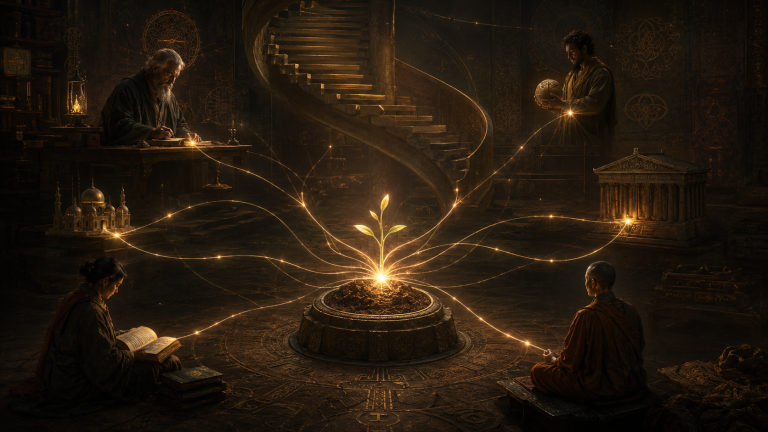
The Seed is the first spark of that direction. Sometimes a sentence, sometimes a loss, sometimes a glance, sometimes a question that suddenly falls inside a person becomes the Seed. The Seed is not passive data; it is an intense sign that moves the place it touches. For Âdem, Camus’s page left such an effect. A personal grievance opened the human search for meaning through that sentence.
The Knot is where the Seed touches. A person, a society, an era, or a civilization can become a Knot. The Knot holds potential within itself; yet often that potential remains asleep until the right Seed touches it. Inside Âdem, the sense of transience accumulated since childhood was already there; the distance left by his father was already there; the words he heard from his grandfather were already there; and the emptiness left by Mavi was already there. Camus’s sentence did not create these from nothing—it only summoned them together.
Context is the space opened by this contact. When the Seed touches the Knot, the person does not only gain new information; they begin to see what they are living through with another pair of eyes. The same event settles into a new order of meaning. That is why, in Panlectic thought, context is not only external conditions. Context is the place where meaning is born. A person does not think within events; they think, get hurt, change, and find direction within this living space where events touch one another.
The idea of trade-offs in engineering finds a strong parallel here. In real life, no solution produces profit only. Balance achieved in one place may generate a new tension in another. As power increases, flexibility may decrease. As speed rises, control can become harder. Depth may be lost while simplicity is preserved.
Human thought is like that too. When a philosopher explains a matter, they may leave the spirit out. Another may place the will at the center while neglecting the context. Another may dismantle language without approaching the silent side of being. In the Panlectic viewpoint, this lack is not seen as a flaw, but as a call from the parts.
Truth is not so narrow that a single hand can grasp it. Every thought touches it at some point. Every great system illuminates one face of reality while casting another face into shadow. That is why Panlectic Philosophy does not read philosophers, beliefs, scientific approaches, or personal experiences as enemies of one another. It treats them as different nodes within a wider fabric of meaning.
In this fabric, spiral movement is determining. People return to the same questions again and again, but they are not standing in the same place each time. A sentence heard in childhood gains another meaning years later. A rupture lived through in youth turns into thought in maturity. When a book is read for the first time, it is only text; years later, it can become a key that opens a person’s own life.
The Panlectic journey does not progress like a straight line. It turns back, checks, deepens, and rises to another layer.
Âdem’s story is the literary face of this spiral. He does not jump from pain directly into a system. First, he waits, breaks, stays silent, reads, meets, and thinks again. Then he begins to sense that what he experiences is not separate from one another. Philosophy is not an abstract endeavor for him; it is the effort to gather the scattered parts of life without hurting them.
Being Panlectic is, in some measure, sustaining this effort. While trying to sense the gears and mechanics behind the curtain, being able to admire the aesthetics of the play on stage. If a person sees only the system, they lose the fragility of life. If they see only the feeling, they miss the order. The Panlectic viewpoint tries to hold both at once: order and pain, mechanism and voice, thought and lived experience.
Panlectic Philosophy sees truth not as a captured result, but as a direction opened within relationships. Knowledge is not an object to be possessed; it is a flow carried, transmitted, and changing as it touches. When one thought passes to another person, it does not remain the same. By touching a new memory, a new pain, a new context, it gains a different resonance.
That is what Âdem lived through in the library. Camus’s sentence did not remain only Camus’s sentence. It touched Âdem’s waiting, Mavi’s absence, the perspective Uncle Münir would teach, and the Panlectic thought that would take shape later. Thus, a novel page became the Seed that awakens the Knot inside a person.
The reason every reader can find a piece of themselves in Âdem also comes from this. There are knots waiting inside all of us. Sometimes a sentence sets them in motion. Sometimes a separation. Sometimes a city. Sometimes a word spoken years ago—its meaning opening only much later.
When a person begins to notice these touches in their own life, they do not just live alone; they also start to see the texture of what they have lived.
Panlectic Philosophy is an attempt to read this texture. Without trapping truth in a single center, it tries to understand how parts bind to one another. It follows how the Seed touches the Knot, which Context is born from that contact, and how all this movement deepens within a spiral.
Thus, thought does not break away from life; it turns toward understanding the invisible order already working within life.
In order to convey our philosophy better, we would like to explain the fundamental concepts further in the links below.



You can start reading our articles for more detailed information.